
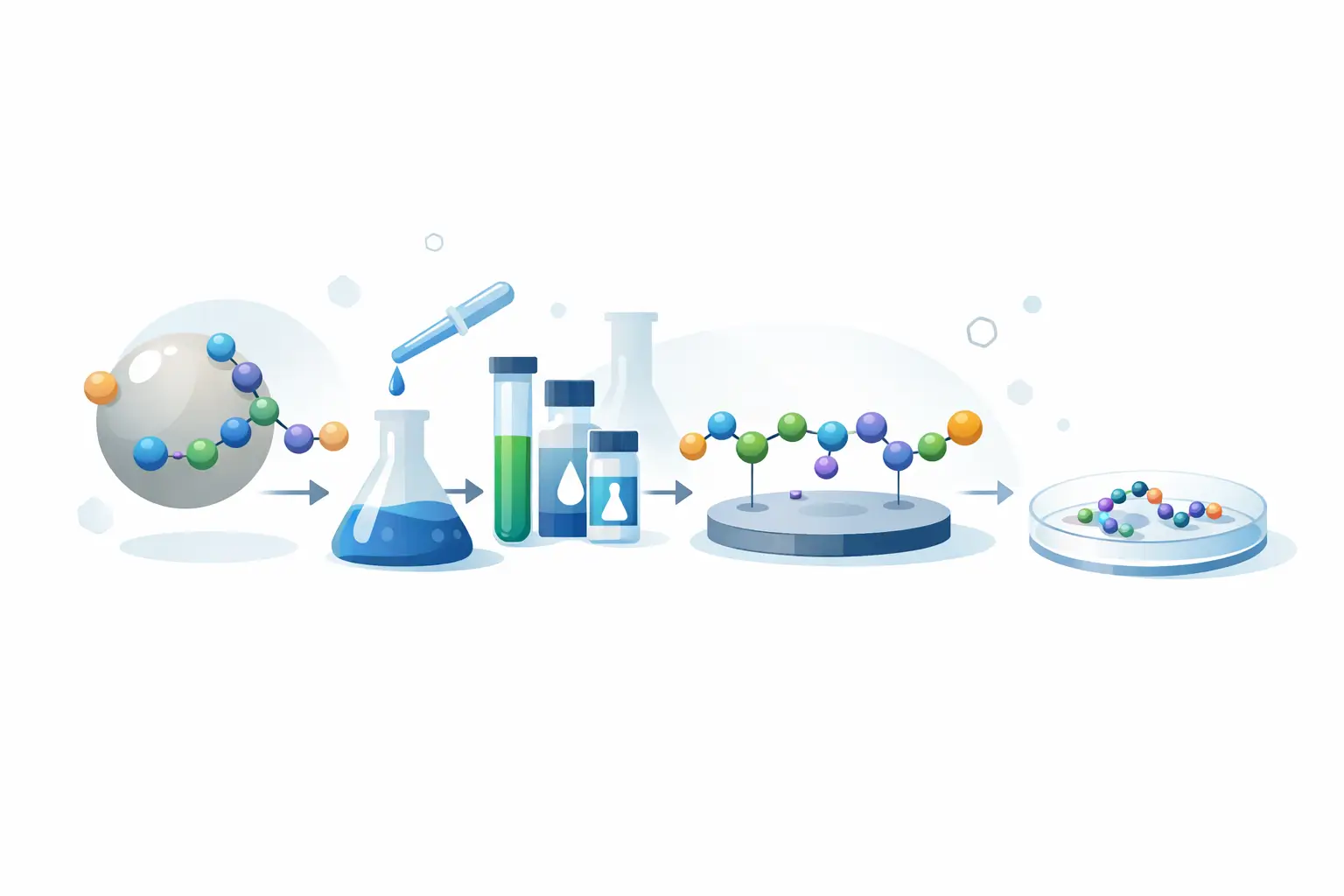
A peptide can look simple on paper and still fail a research program if the manufacturing process introduces sequence errors, residual impurities, or batch inconsistency. That is why the solid phase peptide synthesis process matters so much in research supply. It is not just a production method. It is the framework that determines how reliably a peptide can be assembled, cleaved, purified, and verified before it reaches a laboratory.
For buyers sourcing research-use peptides, the practical question is straightforward: how does a manufacturer turn a target sequence into a material that is consistent enough for analytical or developmental work? The answer starts with controlled, stepwise chemistry performed on a solid support, then continues through deprotection, cleavage, purification, and testing. Each phase affects final quality.
What the solid phase peptide synthesis process actually does
The solid phase peptide synthesis process builds a peptide one amino acid at a time while the growing chain remains attached to an insoluble resin. This design is efficient for manufacturing because reagents and byproducts can be washed away after each reaction cycle without isolating the peptide at every step. That reduces handling complexity and makes repeated coupling steps more manageable.
The method is especially useful for research peptides because it supports precise sequence construction and can be adapted for different chain lengths, protection strategies, and modification requirements. Still, efficiency on paper does not guarantee a clean product. Yield, purity, and sequence fidelity depend on how well each step is controlled.
Step 1 – Resin selection and initial loading
Everything begins with the resin. The solid support is not a minor detail. It influences how the peptide is anchored, how the final product will be cleaved, and what functional group will appear at the C-terminus. Different projects may call for different resin chemistries depending on the target structure.
Once the correct resin is selected, the first protected amino acid is attached. This loading step sets the foundation for the entire synthesis. If loading is uneven or incomplete, downstream coupling efficiency can suffer, and the final peptide population may become less uniform. In a quality-focused workflow, resin substitution and loading capacity are monitored closely because small errors at this stage can compound across the sequence.
Step 2 – Deprotection and coupling cycles
After the initial amino acid is anchored, the repetitive core of synthesis begins. In most modern workflows, the incoming amino acid carries side-chain protection and a temporary N-terminal protecting group. That temporary group is removed first, exposing the amine so the next amino acid can be coupled.
The coupling step then joins the next protected amino acid to the growing chain with the aid of activating reagents. This cycle repeats until the full sequence is assembled. It sounds linear, but this is where many manufacturing differences appear.
A high-performing process depends on reaction completeness. If deprotection is incomplete, the next amino acid cannot attach efficiently. If coupling is incomplete, deletion sequences may form. Those truncated or misassembled fragments can be difficult to separate later, particularly when the target peptide is longer or more hydrophobic.
For that reason, manufacturers often build redundancy into the solid phase peptide synthesis process through optimized reaction times, reagent excess where appropriate, wash control, and monitoring of difficult sequences. Some amino acid combinations are more prone to steric hindrance, aggregation on resin, or side reactions. In those cases, process conditions may need adjustment rather than simple repetition of a standard cycle.
Why sequence complexity changes the risk profile
Not all peptides behave the same way during synthesis. Shorter chains with cooperative chemistry are generally easier to produce cleanly. Longer chains, highly hydrophobic regions, repetitive motifs, or sequences rich in bulky residues can become harder to assemble with high purity.
That does not mean the method is unsuitable. It means process discipline matters more as complexity rises. A credible manufacturing program recognizes those sequence-specific risks early instead of treating every peptide as a commodity.
Step 3 – Capping, washing, and on-resin control
Between major reaction steps, washing removes excess reagents and byproducts from the resin bed. This is one of the quiet strengths of solid-phase synthesis. Because the peptide remains attached to the support, purification between every amino acid addition is unnecessary. At the same time, poor washing can leave reactive carryover that contributes to impurities.
Some workflows also use capping steps to block unreacted chains from continuing through later cycles. That trade-off is useful. Capping can reduce formation of complex mixed impurities, but it also intentionally ends incomplete sequences rather than rescuing them. Whether that is the right approach depends on the synthesis plan, the target purity window, and the ease of downstream purification.
Step 4 – Final deprotection and cleavage from resin
Once the full protected sequence is assembled, the peptide must be released from the resin and stripped of side-chain protecting groups. This is typically done with an acid-based cleavage mixture selected for the resin and protecting strategy used during synthesis.
This step is chemically decisive. If cleavage conditions are too weak, residual protection or incomplete release can reduce recovery and complicate purification. If conditions are too aggressive or poorly balanced, side reactions can damage sensitive residues or create additional impurities. Research-grade manufacturing requires control here, not just speed.
After cleavage, the crude peptide is separated from resin remnants and precipitated or otherwise recovered for purification. At this point, the target molecule exists, but it is still crude material. It may contain truncated sequences, modified side products, residual reagents, and cleavage-related impurities.
Purification is not optional if consistency matters
A common mistake among less technical buyers is to think synthesis alone determines peptide quality. It does not. Even a well-run assembly produces crude output that must be refined.
Purification, often by preparative chromatographic methods, separates the target peptide from closely related impurities. The difficulty of this step depends on the sequence. Some peptides resolve cleanly. Others produce impurity profiles that are more challenging because side products have similar chemical properties.
There is also a practical balance to manage. Pushing for extremely high purity can reduce overall yield and increase cost. Stopping too early may leave material that is less suitable for demanding analytical work. The right target depends on the intended research application, but the key point is simple: purification strategy should align with actual laboratory requirements, not marketing shorthand.
Quality control after the solid phase peptide synthesis process
A research peptide should not be judged by process claims alone. It should be supported by verification. After purification, quality control is used to confirm identity, assess purity, and screen for consistency across batches.
Typical testing may include chromatographic purity analysis and mass confirmation. Depending on the product and manufacturing program, additional testing may be used to support handling quality and overall batch release standards. What matters most is that verification is treated as part of manufacturing, not as an afterthought.
For serious buyers, this is where domestic operational control and laboratory discipline become meaningful. A supplier using cGMP-aligned protocols, controlled synthesis practices, and documented verification procedures is in a better position to deliver repeatable research material than a source competing only on price.
What buyers should look for in a peptide manufacturer
When evaluating peptide supply, ask how the manufacturer manages the full chain from synthesis through release. A reliable answer should address resin-based assembly, controlled cleavage, purification, and laboratory verification. Fast shipping is valuable, but it only matters after product integrity is established.
It is also worth paying attention to what is not promised. No serious research supplier should present peptide manufacturing as error-free or universally simple. Difficult sequences exist. Recovery can vary. Purity targets involve trade-offs. Professional manufacturers communicate those realities clearly while maintaining high process standards.
For research-use procurement, operational reliability matters almost as much as chemistry. Domestic production, responsive support, and consistent fulfillment reduce uncertainty for labs that cannot afford avoidable delays. That is part of the quality equation too.
At Elitegen Labs, that quality equation is approached with a laboratory-first mindset: advanced synthesis methods, controlled post-synthesis processing, verification-focused standards, and strict research-use-only positioning. For buyers who need dependable peptide supply, the process behind the vial is never secondary. It is the reason the material can be trusted for serious laboratory work.
The best sourcing decisions usually come from asking one direct question: not just what peptide is being sold, but how carefully it was made.