
The difference between a usable research peptide and a problematic one often comes down to what happens after synthesis. If you want to understand how peptides are purified, you have to look past the peptide sequence itself and focus on the impurities created during assembly, cleavage, and handling. Purification is not a finishing touch. It is a control step that determines whether a batch is suitable for analytical and development work.
For research buyers, that matters because crude peptide material can contain closely related byproducts that are hard to separate without the right process controls. A peptide may be synthesized correctly in principle, yet still carry truncated sequences, deletion products, protecting group remnants, oxidation products, or salts from downstream processing. Purification is the stage where those variables are reduced to a defined specification.
How peptides are purified after synthesis
Most modern peptides are produced by solid-phase peptide synthesis, where amino acids are added step by step on a resin. That approach is efficient, but it does not produce a perfectly clean final material on its own. Even in a well-controlled synthesis, side reactions and incomplete coupling events can occur. Once the peptide is cleaved from the resin and deprotected, the crude mixture typically contains the target peptide plus a range of structurally similar impurities.
That is why purification begins immediately after synthesis and cleavage. The crude material is first collected and prepared in a solvent system suitable for separation. At this stage, labs are not simply trying to remove obvious contamination. They are separating compounds with very small chemical differences, which is why peptide purification requires analytical discipline rather than basic filtration or washing.
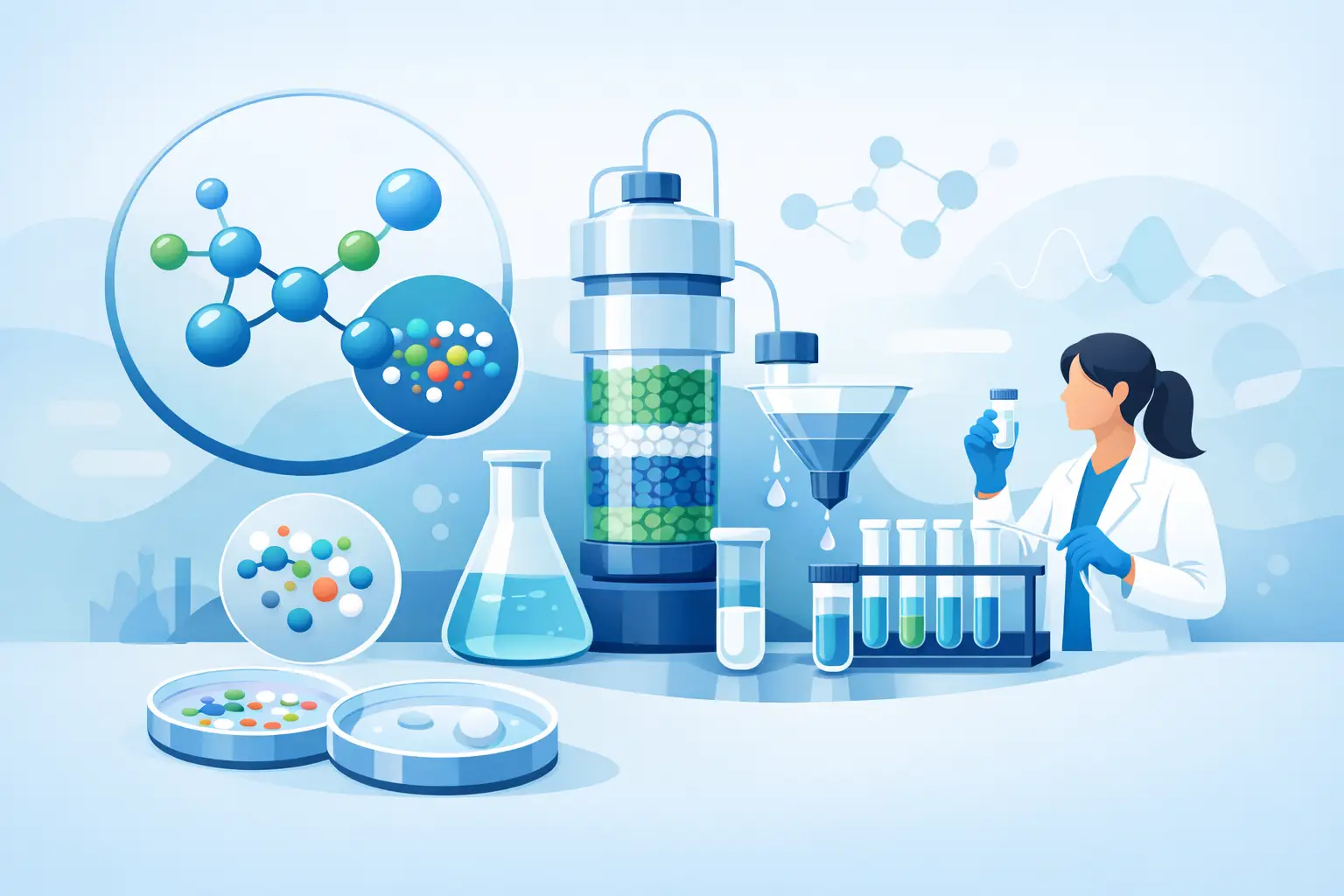
The most common and most important purification method is high-performance liquid chromatography, usually reverse-phase HPLC. In this process, the crude peptide solution passes through a chromatography column packed with a stationary phase, often C18 material. Different compounds interact with that stationary phase differently based on hydrophobicity, charge distribution, sequence length, and conformation. As the mobile phase changes over time, individual components elute at different retention times.
That separation is the core of the process. The target peptide appears as a defined peak, while impurities appear as earlier or later peaks depending on their properties. Fractions are collected selectively, then reviewed by analytical testing before being pooled. In practical terms, purification is not just running a batch through a column. It is deciding which fractions truly match the intended peptide and which ones do not.
Why reverse-phase HPLC is the standard
Reverse-phase HPLC is widely used because peptides respond well to it, and because it gives labs a repeatable way to separate compounds that differ by only one amino acid or one side product. A deletion peptide, for example, may be very close in structure to the target sequence, but still separate under the right gradient conditions.
The mobile phase usually includes water and an organic solvent such as acetonitrile, often with an acid modifier like trifluoroacetic acid or formic acid. The gradient is adjusted to improve resolution between the target compound and neighboring impurities. This is where process expertise matters. If the gradient is too aggressive, peaks can overlap. If it is too conservative, throughput drops and recovery may suffer.
That trade-off is real. Higher purity is generally desirable, but pushing purification too far can reduce total yield. Labs have to balance purity targets, recovery, sequence behavior, and the intended research specification. Some peptides purify cleanly with strong separation margins. Others are more difficult because the impurity profile closely tracks the target peptide.
The impurities labs are trying to remove
When buyers see a purity value on a specification sheet, it helps to know what sits behind that number. In peptide work, impurities are rarely random debris. Many are chemically related byproducts formed during synthesis or post-synthesis handling.
Common examples include truncated sequences from incomplete coupling, deletion peptides, amino acid substitutions, incompletely deprotected material, residual cleavage reagents, oxidized variants, and aggregation-related byproducts. There can also be residual solvents, counterions, or moisture concerns depending on the final processing and storage conditions.
Some impurities are easier to remove than others. Residual small molecules may be addressed through washing, precipitation, or lyophilization steps. Closely related peptide impurities are the harder problem, and that is where chromatographic resolution becomes critical. A laboratory-grade process has to identify which impurity classes matter most for the specific peptide and adjust purification accordingly.
What happens after the chromatography run
Purification does not end when the target fraction is collected. Once the appropriate fractions are pooled, the material is typically processed to remove solvents and prepare it for final analytical review. This often includes concentration, desalting when needed, and lyophilization to produce a stable dry powder.
At this point, analytical confirmation becomes essential. A purified peptide still has to be verified for identity and assessed for purity. Analytical HPLC is commonly used to measure purity under standardized conditions, while mass spectrometry is used to confirm molecular weight and support identity assignment. Depending on the product and internal quality framework, additional testing may include moisture content, residual solvent review, appearance, or peptide content evaluation.
This distinction matters. Preparative HPLC is used to separate and collect the peptide. Analytical HPLC is used to verify what was collected. Strong manufacturing practice relies on both.
How labs verify that purification worked
A serious peptide workflow does not rely on a single data point. Purity percentages are useful, but they do not tell the full story unless they are supported by identity testing and batch-level review.
Analytical HPLC shows the peak profile and estimates the relative abundance of the target peptide versus detectable impurities. Mass spectrometry confirms that the principal peak corresponds to the expected molecular mass. When those two data sets align, labs have a stronger basis for release decisions.
There are still limits to what any single test can prove. Purity can vary depending on method conditions, detection wavelength, and peptide behavior in the assay. Some impurities may co-elute if the method is poorly optimized. That is why method development and internal controls matter as much as the instrument itself.
For research-use buyers, the practical takeaway is straightforward. Purification quality is not just about advertising a high number. It is about whether the supplier has a controlled process for separation, fraction selection, and verification.
How peptides are purified consistently at scale
Small-scale peptide purification and production-scale purification are related, but not identical. A method that works for a development batch may require adjustment when the peptide is produced at a larger scale. Column loading, solvent flow, fraction timing, and resolution windows all affect consistency.
That is where domestic operational control and process discipline become valuable. Consistency across batches depends on controlled synthesis conditions, repeatable purification parameters, and laboratory verification standards that do not shift from run to run. For buyers sourcing research materials, this is often more important than chasing the lowest price point.
At Elitegen Labs, that quality expectation aligns with a laboratory-focused model built around U.S.-based production oversight, verification, and cGMP-aligned process discipline for research-use materials. The goal is not simply to make peptides. It is to deliver batches with the consistency and integrity that analytical and development work demands.
What research buyers should pay attention to
If you are evaluating peptide quality, ask how the material was purified, how identity was verified, and whether the supplier treats purification as a defined control step rather than a marketing phrase. A peptide with a documented chromatographic purification workflow and batch-level verification offers a stronger foundation for research than crude or loosely characterized material.
It also helps to keep expectations realistic. Some sequences are inherently more challenging than others, and purity targets are always shaped by chemistry, recovery, and intended application. The right question is not whether purification is perfect. The right question is whether the process is controlled, repeatable, and appropriate for the peptide being supplied.
That is usually where reliable sourcing begins – with suppliers who can explain the path from crude synthesis to verified final material in clear, technical terms and who treat quality control as part of the product, not an afterthought.